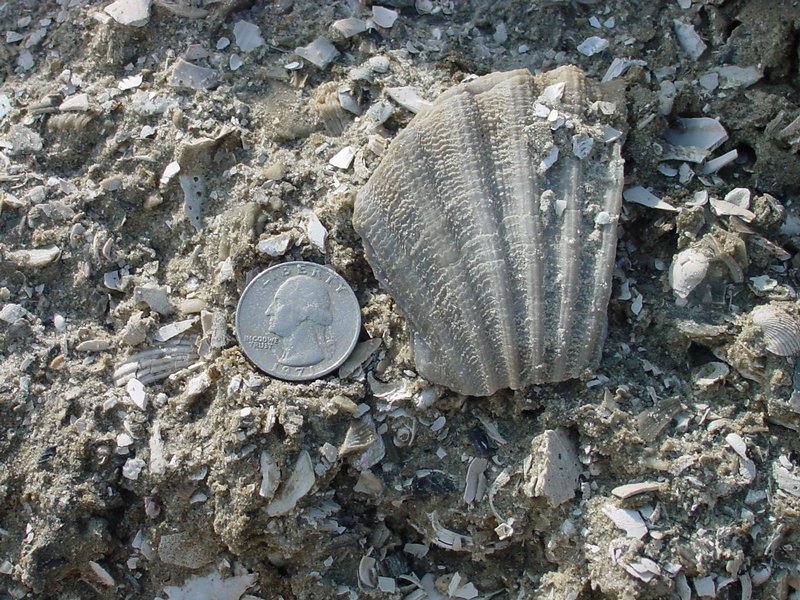
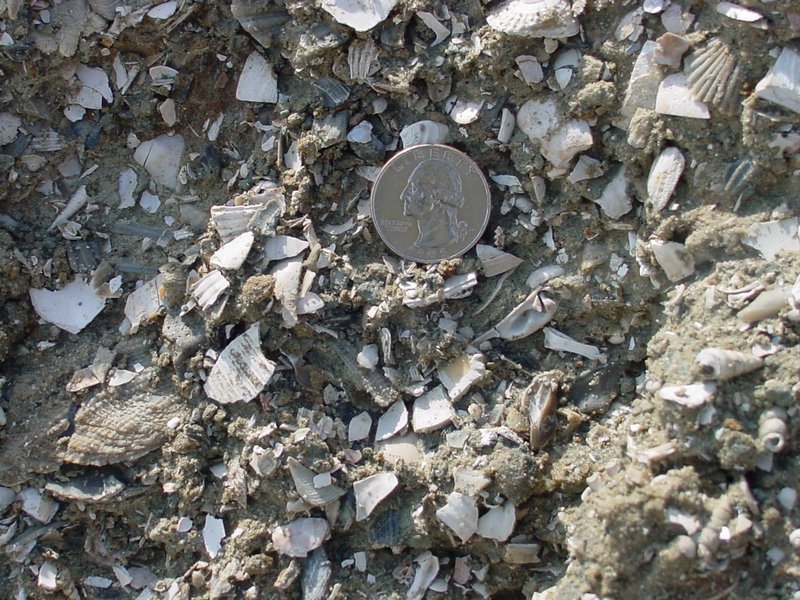
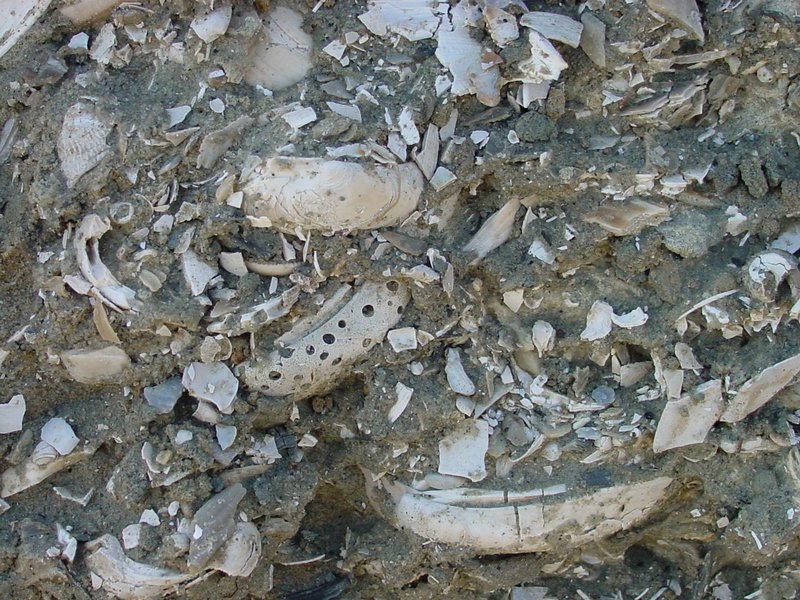
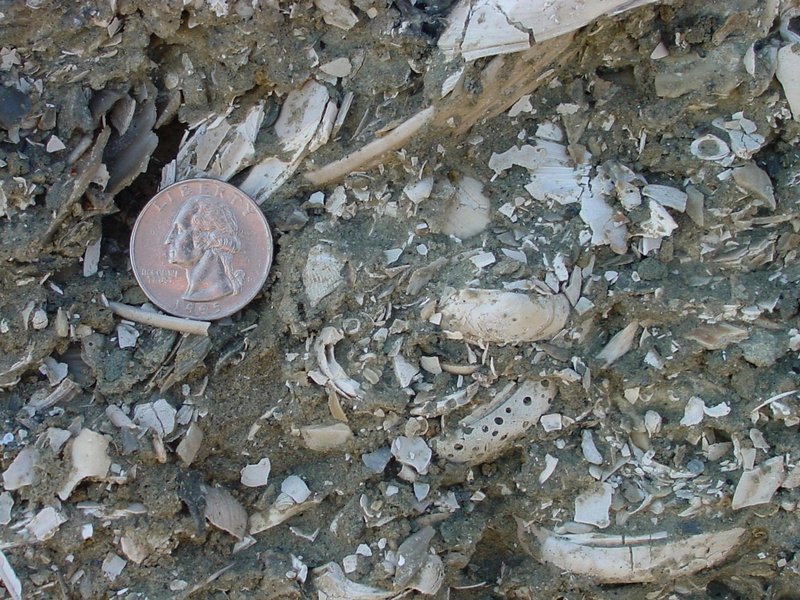
Click on image to enlarge.
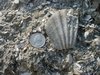
|
Title: Information Sheet, Drumcliff Member
Instructors' Note
A student in History of Life (spring 2003) at Georgetown University (GU), Washington, D.C., produced this report as an individual class project which had a limit of about 30 hours.
Goals of the projects include:
(1) Learning about the biodiversity of marine life of the Drumcliff Member, Choptank Formation, of the Maryland Miocene.
(2) Producing an online scientific report regarding this subject for interested parties.
These are short pilot projects that lay groundwork for further investigation.
To see all five of these projects, please use the keyword HOL2003R on this Website.
Projects of future History of Life students might continue the line of investigation of the 2003 projects.
Because it is illegal to dig in the Calvert Cliffs, our class collected material from slumps at the base of cliffs. Our class did not dig into the Cliffs.
We thank Mrs. Pat Fink (Calvert County Marine Museum) for her special help with this project.
E. M. Barrows and L. K. Peirson, instructors
Literature Cited and Refernces
Ashby, Wallace L.
2003.
Fossils of Calvert Cliffs.
http://calvert-county.com/fossils.htm
(25 March 2003)
Ashby, Wallace L.
1995.
Fossils of Calvert Cliffs. Solomons, MD.
Calvert Marine Museum Press, Solomons, MD.
19 pp.
Blackwell, E.
1999.
Westmoreland State Park Fossil Collecting: Background Information.
Mary Washington College.
Internet file.
http://www.mwc.edu/eesg/paleo/Westmorelandhome.htm#two
(25 March 2003)
Barrows, E. M.
2003.
HOL Class Individual Projects (class handout).
Barrows, E. M.
2001.
Animal Behavior Desk Reference.
A Dictionary of Animal Behavior, Ecology, and Evolution.
Second Edition. CRC Press, Boca Raton, FL.
936 pp.
Collaborative Virtual University Education Program.
2001.
The Shannon Weaver Index.
Internet file.
http://www.miljolare.no/virtue/newsletter/01_04/news/shannon.php
(3 April 2003)
[Note: The title does not hyphenate Shannon-Weaver.]
Fink, Pat.
2002.
Unit 17, the Drumcliff Member, Choptank Formation.
The Ecphora August 2002: 8–11.
( http://www.calvertmarinemuseum.com/cmmfc/newsletter/newsletter_2002-08.html )
Guertin, Laura.
1999.
Calvert Cliffs, Maryland.
Internet file.
http://www.mwc.edu/eesg/paleo/Calvert/Stratigraphy.html
(25 March 2003)
Lagassé, P., ed.
2002.
The Columbia Encyclopedia, Sixth Edition.
Miocene Epoch.
Internet file.
http://www.bartleby.com/65/mi/Miocene.html
(26 March 2003)
Maryland Department of Natural Resources.
2002.
Calvert Cliffs State Park.
http://www.dnr.state.md.us/publiclands/southern/calvertcliffs.html
(25 March 2003).
McLennan, J. D.
1973.
Calvert Cliffs, Maryland.
Maryland Geological Survey.
Internet file.
http://www.mgs.md.gov /esic/brochures/ccliffs.html
(25 March 2003)
New South Wales Department of Mineral Resources.
1996.
Fossils.
Internet file.
http://www.minerals.nsw.gov.au/minfacts/61.htm
(3 April 2003)
Shattuck, George Burbank.
1904.
Geological and Paleontological Relations, with a review of earlier investgations.
In Fink (2002).
Topinka, L.
2001.
The Geologic Time Scale.
U.S. Department of the Interior, U.S.
Geological Survey/Cascades Volcano Observatory.
Internet file.
http://vulcan.wr.usgs.gov/Glossary/geo_time_scale.html
(25 March 2003)
Table 1. Fossil taxa known from the Drumcliff Member, Maryland Miocene in 2003
Notes:
Common names within quotes are names coined by E. M. Barrows for teaching purposes.
Numbers are in front of a species, putative species, or a taxon name that represents it.
Crabs and ostracods are each counted as one species because Fink (2002) does not designate the number of species.
I did not try to identify bryozoans, and, for convenience, tallied the two specimens as the same species.
The numbers that follow a taxon (in parentheses) are the number of individuals found in each of five samples and the total number of individuals, respectively.
Sample 1 is from Alexander S. Baras; 2, Bradley W. Fehrenbach; 3, Joseph E. McClain; 4, Laura K. Peirson; 5,
Marc A. Sanidad; 6, all five samples combined).
Kingdom Animalia
Phylum Arthropoda
Order Cirripedia (Thoracica) (Barnacles)
Balanidae
001.
Balanus sp. (17, 7, 4, 58, 31, 117)
002. Order Decapoda (Crabs) (1, 0, 0, 0, 0, 1)
003. Order Ostracoda, an unknown number of species
Phylum Brachiopoda
Order Acrotretida
Discinidae
004.
Discinisca lugubris (Conrad) ("Mournful Brachiopod")
005. Phylum Bryozoa (0, 1, 0, 0, 1, 2)
Order Chilostomata Busk
Membraniporidae
006.
Membranipora bifoliata (“Bifoliated Moss Animal”)
007.
Membranipora fossulifera (“Fossil-forming Moss Animal”)
008.
Membranipora germana (“German Moss Animal”)
Lapralidae
009.
Palmicellaria convoluta (“Convoluted Moss Animal”)
Retroporidae
010.
Retropora doverensis (“Dover Moss Animal”)
Microporellidae
011.
Microporella ciliata (“Ciliated Moss Animal”)
Schizoporellidae
012.
Schizoporella latisinuata (“Latticed Moss Animal”)
Phylum Chordata
Class Chondrichthyes (Cartilaginous Fishes, including Rays and Sharks)
Alopiidae
013.
Alopias sp.
Carcharhinidae
014.
Carcharhinus sp.
015.
Galeocerdo sp.
016.
Negaprion sp.
017.
Hemigaleidae
018.
Hemipristis serra (Requium Shark = Snaggletooth Shark)
Lamnidae
019.
Isurus hastalis (Hastalate Mako Shark)
Myliobatidae
020.
Aetobatus sp.
021.
Myliobatis sp.
Class Osteichthyes (Boney Fishes)
Scianeidae
022.
Pogonias sp. (black drum fish)
Class Mammalia
Order Cetacea (Dophins, Porpoises, Whales)
023. Cetotheriidae (Baleen Whales)
Order Artiodactyla
Tayassuidae
024.
Prosthenops cf.
niobarensis (peccary)
Class Reptilia (Reptiles)
leatherback turtle (species unknown)
Cheloniidae
025.
Syllomus cf.
S. aegyptiacus ("Egyptian Leatherback Turtle")
Crocodylidae
026.
Gavialosuchus antiqua (Miocene Crocodile)
Dermochelyidae
027.
Psephophorus calvertensis ("Calvert’s Leatherback Turtle")
Phylum Cnidaria
Order Anthozoa
028.
Astrhelia palmata ("Palmate Coral") (1, 0, 1, 3, 12, 17)
Order Hydrozoa
029.
Hydractinia sp.
Phylum Echinodermata
Class Echinoidea
Scutellidae
030.
Abertella aberti Conrad ("Abert’s Sand-dollar") (2, 3, 3, 4, 3, 15)
Spatangidae
031.
Echinocardium orthnotum (Miocene Heart Urchin)
Phylum Mollusca
Class Cephalopoda
Retusidae (= Tornatinidae)
032.
Volvula Adams
Class Gastropoda
Caecidae
033.
Caecum
Cancellariidae (Nutmeg Shells)
034.
Cancellaria alternata Conrad (“Alternate Nutmeg Shell”)
035.
Cancellaria cf.
C. biplicifera
Columbellidae
036. ?
Mitrella
Crepidulidae
037.
Crepidula fornicata (Linnaeus) ("Fornicating Slipper Shell")
038.
Crucibulum costatum (Say) ("Ribbed Crucible Shell")
039.
Crucibulum multilineatum Conrad ("Multilinear Crucible Shell") (2, 1, 2, 1, 0, 6)
Epitoniidae (Wentle-traps)
040.
Epitonium expansa ("Expanded Wentle-trap")
Fasciolariidae
041.
Chrysodomus patuxentensis (“Patuxent Snail”)
042.
Siphonalia devexa (Conrad) (“Sloped Snail”)
Fissurellidae (Keyhole Limpets)
043.
Fissuridea cf.
F. griscomi (Conrad) ("Griscom’s Keyhole Limpet")
044.
Fissuridea cf.
F. nassula
Melongenidae (Horse Conchs)
045.
Busycotypus rugosum ("Rough Lighnting Welk")
Muricidae (Murex Family)
046.
Ecphora meganae meganae ("Megan’s Ecphora Snail") (0, 0, 4, 3, 0, 7)
Nassariidae
047.
Nassarius peralta Conrad (“Pearly Narrow-neck Snail”)
048.
Nassarius cf.
N. peraltoides
Naticidae (Moon Snails = Moon Shells)
049.
Lunatia heros (Say) (Common Northern Moon Snail) (0, 4, 8, 1, 0, 13)
050.
Lunatia cf.
L. hemicrypta ("Hemicryptic Moon Snail")
051.
Polinices duplicatus (Atlantic Moon Snail) (0, 0, 0, 0, 2, 2)
052.
Sinum fragilis (Conrad) (Baby’s Ear)
Terebridae (Auger Shells)
053.
Terebra Adanson
Trochidae (Top Shells)
054.
Calliostoma aphelium Dall ("Smooth Beautiful-mouth Top Snail")
055.
Caliostoma philanthropus (Conrad) ("Philanthropic Beautiful-mouth Top Snail") (0, 0, 0, 0, 1, 1)
Turridae (Turrids)
056.
Cymatosyrinx limatula (“Small Pipe Snail”)
057. "
Drillia" sp.
058. ?
Gemmula cf.
G. bellacrenata
059. ?
Hemipleurotoma
Turritellidae (Top Shells)
060.
Turritella plebeia Say (Common Top Shell) (22, 50, 32, 50, 0, 165)
061.
Turritella plebeia plebeia
062.
Turritella subvariabilis (Conrad) ("Subvariable Top Shell’) (0, 4, 3, 0, 0, 7)
063.
Turritella subvariabilis cf.
T. s. dianae
Vermetidae
064.
Lemintina granifera (Say) (“Pellet-bearing Worm Snail”)
Vitrinellidae (Vitrinellids = Vitrinella Shells)
065.
Teinostoma calvertense (“Calvert’s Narrow-mouthed Snail”)
066.
Vitrinella cf.
V. libara
Volutidae (Volutids = Volutes)
067.
Scaphella virginiana ("Virginia Volute")
Mollusca: Class Pelecypoda
Arcidae (Arc Shells)
068.
Dallarca elevata (=
Dallarca staminea (Say)) (1, 5, 9, 1, 3, 19) (“Elevated Dall’s Arc Shell”)
069.
Dallarca elnia (“Elnia Dall’s Arc Shell”)
Astartidae (Astartids = Arc Shells)
070.
Astarte thisphila (“Thisphila Arc Shell”) (0, 0, 0, 0, 1, 1)
Cardiidae
071.
Chesacardium laqueatum (Conrad) ("Fluted Chesapeake Cockle") (1, 18, 47, 67, 39, 172)
072.
Chesacardium laqueatum blackwelderi ("Blackweld’s Fluted Chesapeake Cockle")
Carditidae (Carditids = Carditas)
073.
Cardita granulata (“Granulated Cardita”)(0, 0, 0, 0, 1, 1)
074.
Carditameria protracta (Conrad) (“Elongated Cardita”)
Condylocardiidae
075.
Erycina sp.
Corbulidae (Corbula Clams)
076.
Bicorbula idonea Conrad ("Fit Corbula Clam")(6, 0, 7, 9, 8, 30)
077.
Corbula inaequalis Say ("Unequal Corbula Clam") (0, 12, 0, 3, 0, 15)
Crassatellidae (Crassinellids = Crassinellas)
078.
Marvacrassatella turgidula (Conrad) ("Distended Marvacrasatella") (2, 17, 2, 0, 0, 21)
Cutellidae (= Solenidae, Jackknife and Razor Clams)
079.
Ensis sp. (jacknife clam)
Gariidae (Gariids = Sanquin Clams)
080.
Gari gubernatoria (“Governors’ Sanquin Clam”)
Glossidae
081.
Glossus marylandicus ("Maryland Tongue Shell") (6, 0, 1, 0, 2, 9)
Hiatellidae
081.
Hiatella arctica
082.
Panopea americana ("American Geoduck Clam")
083.
Panopea goldfussi Wagner ("Gold fuss’ Geoduck Clam")
Isognomonidae (Isognomonids = Tree Oysters)
084.
Isognomon maxillata ("Giant Tree Oyster") (6, 2, 4, 16, 13, 41)
Lasaeidae
085.
Aligena aequata (“Equal-winged Shell”)
086.
Aligena cf.
A. pustulosa
087.
Bornia mactoroides
088. ?
Kellia cf.
K. rotunda
Lucinidae (Lucinids = Lucines)
089.
Lucinoma contracta (Conrad) ("Contracted Lucine") (0, 0, 0, 0, 1, 1)
090.
Parvilucina crenulata (Conrad) ("Crenulated Lucine")
091.
Parvilucina cf.
P. prunus ("Prune-shaped Lucine")
092.
Stewartia anodonta (Say) ("Upward-toothed Lucine")
Mactridae (Mactra Surf Clams)
093. "
Spisula"
subcuneata (0, 0, 23, 8, 0, 31)
Mytilidae (True Mussels)
094.
Modiolus ducatelli Conrad ("Ducatell’s Mussel")
095.
Mytilus conradinus d’Orbigny ("Conrad’s Mussel")
Noetiidae
096.
Striarca centenaria
Nuculidae
097.
Nucula sinaria Dall
098.
Nucula sp. cf.
N. taphria
Ostreidae (Ostreids = Oysters)
099.
Ostrea sp. cf.
O. carolinensis ("Carolina Oyster")
Pectinidae (Pectinids = Scallops)
100.
Chesapecten marylandica ("Maryland Chesapeake Scallop")
101.
Chesapecten nefrens Ward and Blackwelder ("Nefrens Chesapeake Scallop")(43, 44, 124, 63, 83, 357)
Petricolidae (False Angel Wings)
102.
Pleiorytis calvertensis Dall ("Calvert’s False Angel Wing") (0, 0, 0, 1, 0, 1)
Semelidae (Semilids = Semele Clams)
103.
Semele carinata (Conrad) (“Carinated Semele Clam”)
104.
Semele subovata Say (“Subovate Semele Clam”)
Tellinidae (Tellinids = Tellins)
105.
Florimetis biplicata (Conrad) (“Biplicated Tellin”) (0, 0, 0, 0, 1, 1)
106. ?
Tellina sp. (tellin)
Ungulinidae
107.
Diplodonta acclinis
108.
Timothynus subvexa
Veneridae (Venus Clams)
109.
Callocardia subnasuta (Conrad)
110.
Dosinia acetabulum (1, 0, 10, 19, 1, 31)
111.
Dosinia acetabulum blackwelderi
112.
Macrocallista marylandica (Conrad) (0, 0, 11, 0, 9, 20)
113.
Mercenaria cuneata (Hardshell Clam) (4, 4, 8, 7, 2, 25)
Class Scaphopoda (Tusk Shells)
Siphonodentaliidae
114.
Cadulus thallus (Conrad)
115. Phylum Porifera (sponge-damaged mollusc shell) (1, 3, 1, 3, 6, 13)
116. Kingdom Plantae (piece of wood) (0, 0, 0, 2, 0, 2)
|
Table 2. Characteristics of fossil samples from the
Drumcliff Member, Maryland Miocene given in Table 1.
|
|
Characteristic
|
Sample*
|
|
-
|
1
|
2
|
3
|
4
|
5
|
1–5
|
|
Species richness
|
16
|
15
|
20
|
19
|
20
|
32
|
|
Number of individual fossils
|
129
|
173
|
306
|
322
|
217
|
1147
|
|
H' (Shannon-Weaver Index)
|
1.99
|
2.06
|
2.11
|
2.20
|
2.02
|
2.36
|
|
E (Evenness = H'/ max H')
|
0.72
|
0.76
|
0.70
|
0.75
|
0.67
|
0.69
|
*Sample 1 is from Alexander S. Baras; 2, Bradley W. Fehrenbach; 3, Joseph E. McClain;
4, Laura K. Peirson; 5, Marc A. Sanidad.
|
Table 3. Fossil samples from 2003 from Calvert Beach,
Maryland Miocene.
|
|
Phylum
|
Sample
|
|
Approximate known number of species from the literature
|
Class pooled sample*
|
| – Domain Bacteria |
1
|
0
|
| – Domain Eukarya, Kingdom Animalia |
0
|
0
|
| Phylum Annelida (Annelid Worms) |
1
|
0
|
| Phylum Arthropoda (Arthropods) |
10
|
2
|
| Phylum Brachiopoda (Lamp Shells) |
1
|
0
|
| Phylum Bryozoa (Moss Animals) |
30
|
0
|
| Phylum Chordata (Chordates) |
77
|
| Table 1. Raw data on plant height, leaf mine number,
heights, and locations, and external herbivory. |
| Plant number |
Plant height (cm) |
Leaf mine number |
Number of mines per leaf |
Height of leaf mine (cm) |
Mine high or low on plant |
Location of mine on leaf (central or peripheral) |
Location of herbivory on leaf (central, peripheral, both,
or none) |
| 1 |
93 |
1 |
1 |
37 |
L |
C |
C |
| |
|
2 |
1 |
39 |
L |
C |
C |
| |
. |
3 |
1 |
50 |
H |
C |
P |
| |
. |
4 |
1 |
53 |
H |
C |
C |
| |
. |
5 |
1 |
57 |
H |
.
7 |
1 |
88 |
H |
Please click on images to enlarge them.
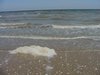
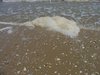
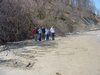
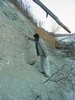
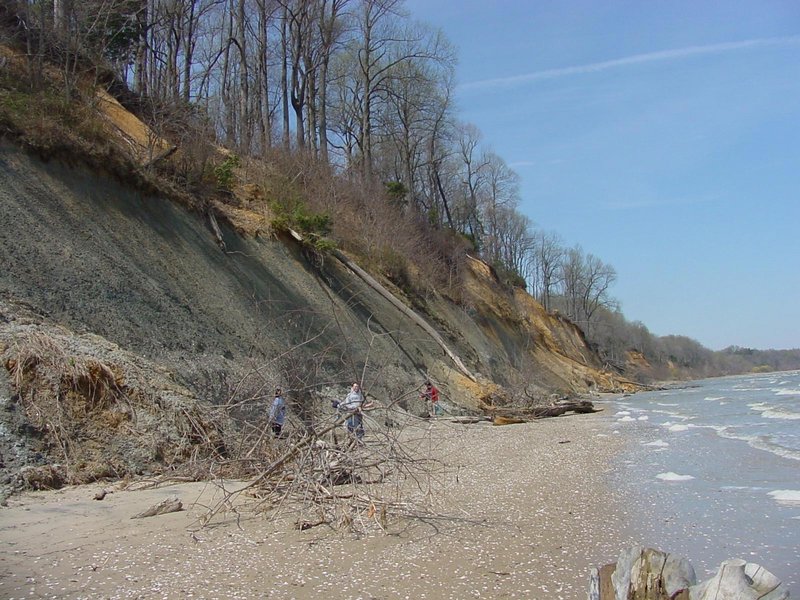
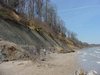
Figure 1.
The Calvert Cliffs at Calvert Beach, looking north, 6 April 2003.
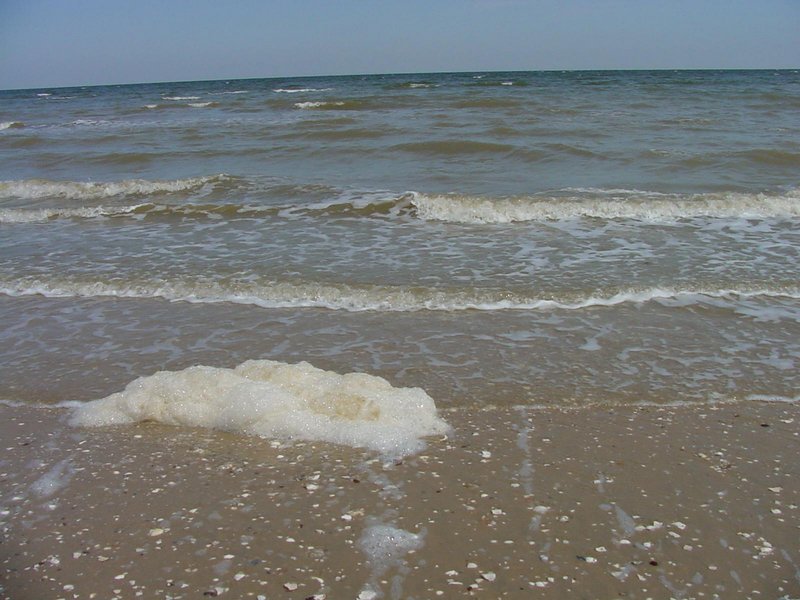
Figure 2.
Waves and foam at Calvert Beach, looking east, 6 April 2003.
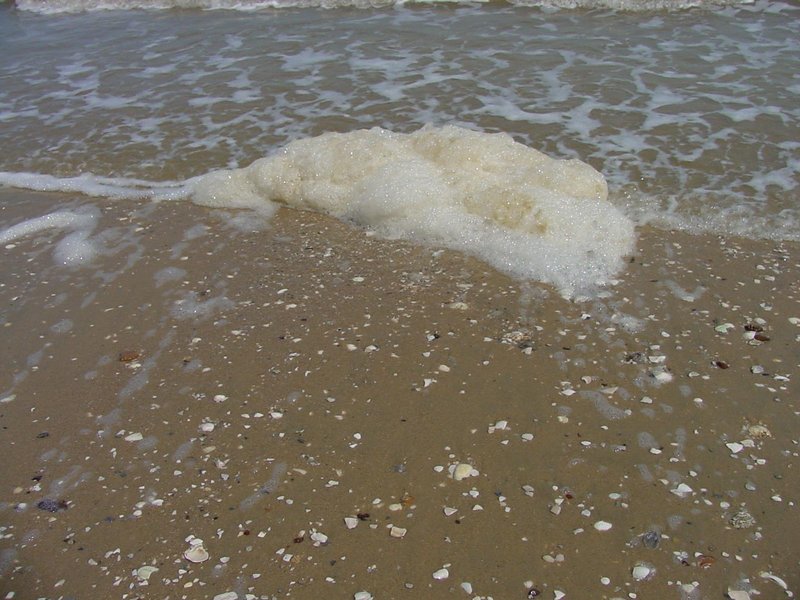
Figure 3.
Foam at Calvert Beach, 6 April 2003.
Figure 4.
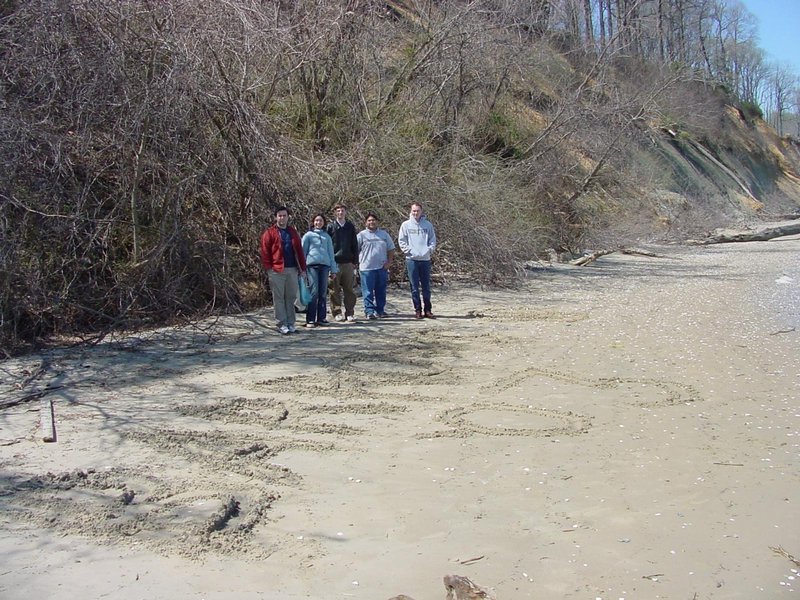
The 2003 History of Life Class at Calvert Beach, 6 April 2003.
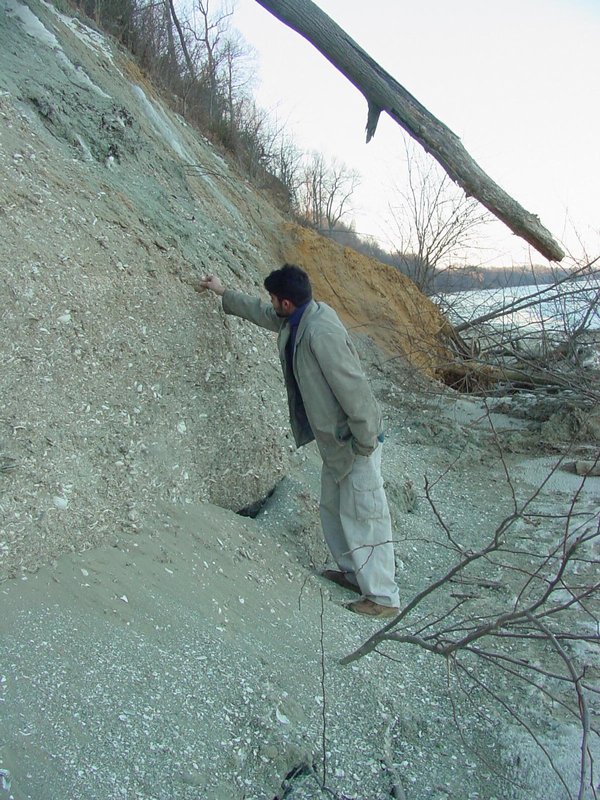
Figure 5.
Mirage examines a slump from the Drumcliff Member, 25 January 2003.
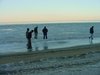
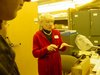
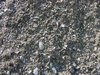
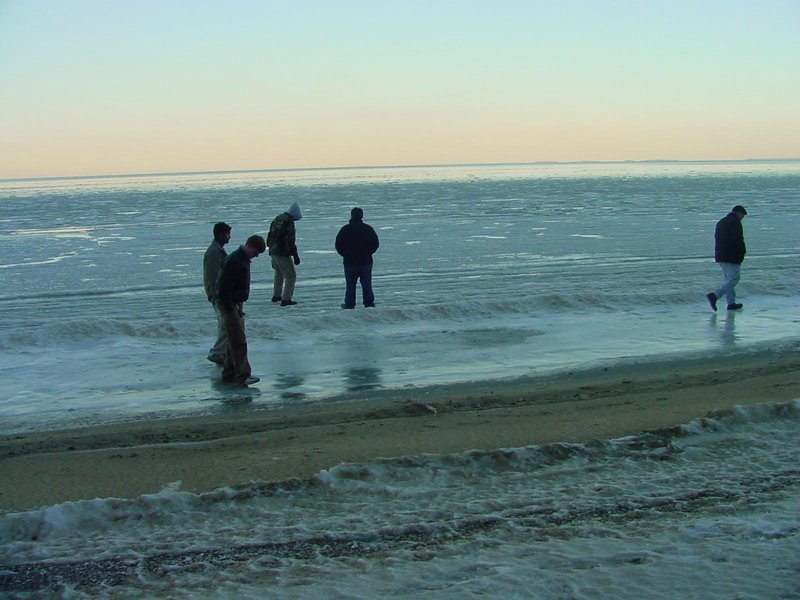
Figure 6.
Students test the ice at Calvert Beach, 25 January 2003.
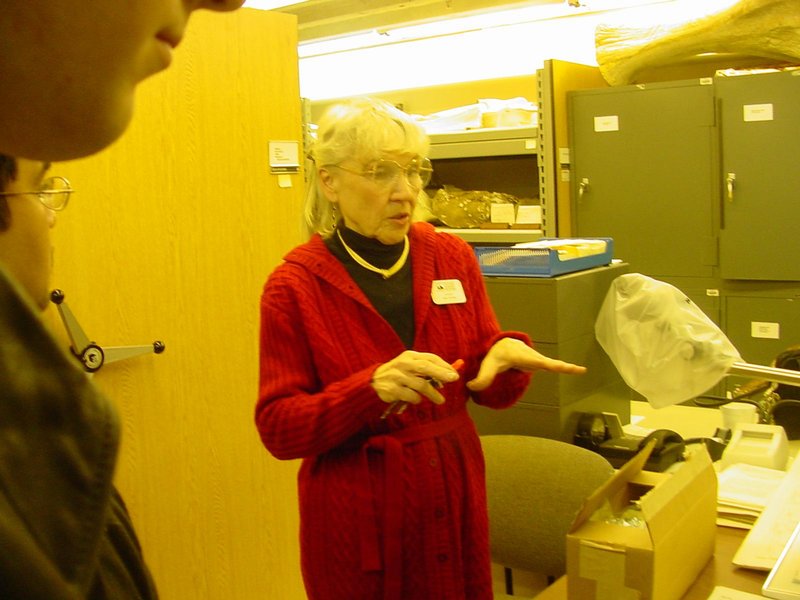
Figure 7.
Mrs. Pat Fink at the Calvert Marine Museum, 25 January 2003.
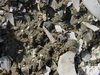
Figure 8.
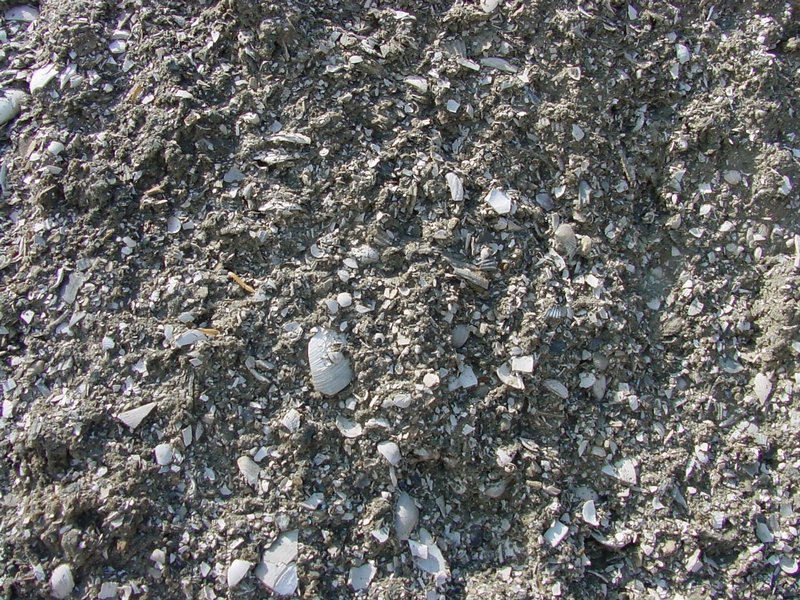
Slump material from the Drumcliff Member, 6 April 2003.
Figure 9.
Slump material from the Drumcliff Member, 6 April 2003.
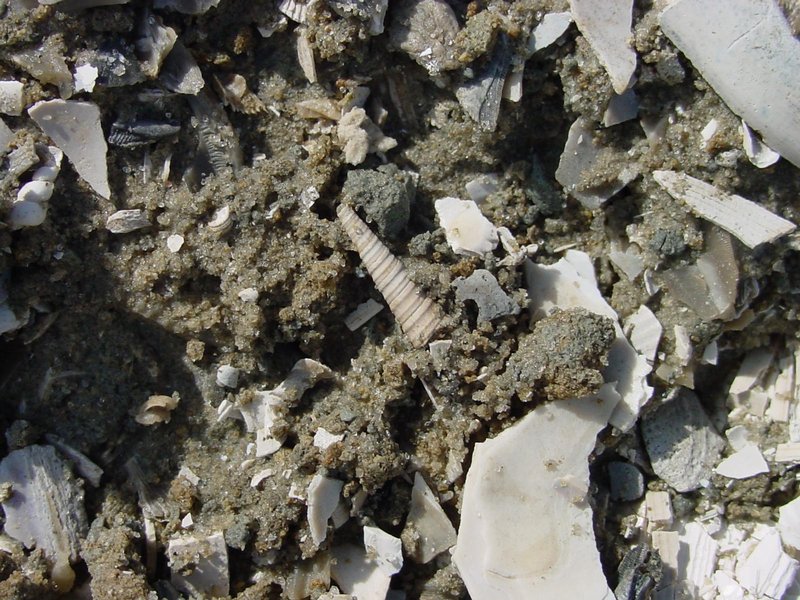
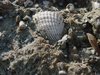
A
Turritella subvariabilis is in the central area of matrix and fossil pieces
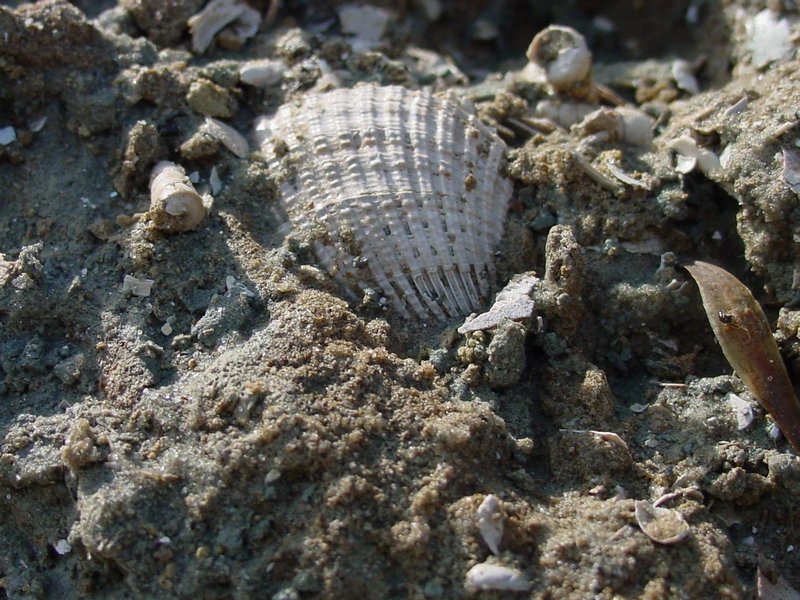
Figure 10.
Slump material from the Drumcliff Member, 6 April 2003.
A large
Chesacardium laqueatum is in the central area.
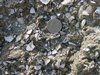
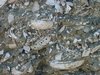
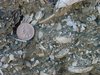
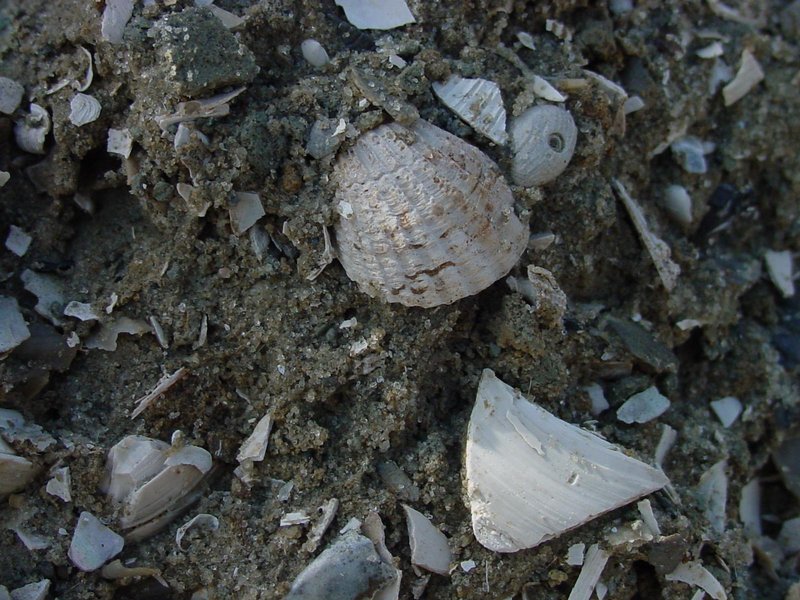
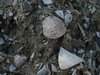
Figure 11.
Slump material from the Drumcliff Member, 6 April 2003.
A small
Chesacardium laqueatum and moon snail with a bore hole is in the central area.
Figure 12.
Slump material from the Drumcliff Member, 6 April 2003.
A piece of
Chesapecten nefrens and quarter area in the central area.
Figure 13.
Slump material from the Drumcliff Member, 6 April 2003.
Figure 14.
Slump material from the Drumcliff Member, 6 April 2003.
Pieces of
Mercenaria cuneata, one piece with many sponge-made holes.
Figure 15.
Slump material from the Drumcliff Member, 6 April 2003.
Pieces of
Mercenaria cuneata, one piece with many sponge-made holes with a quarter for scale.
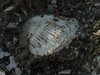
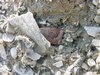
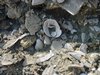
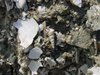
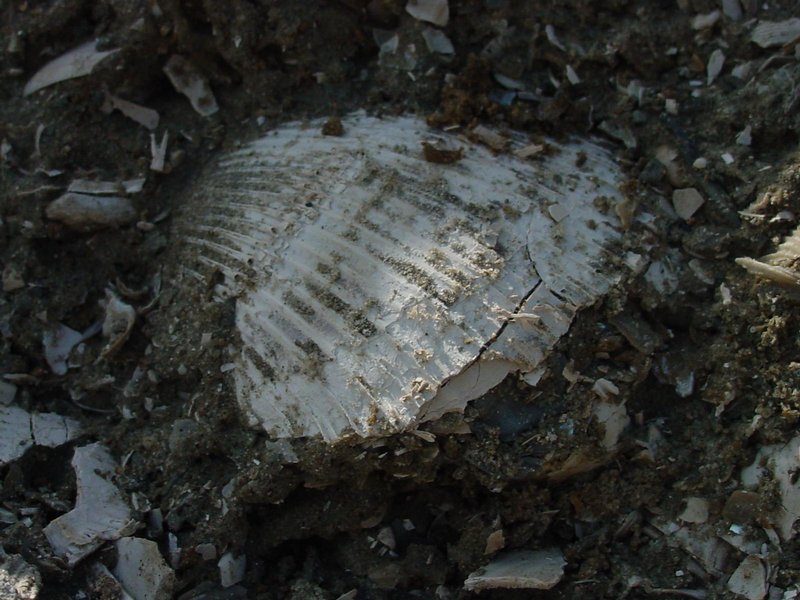
Figure 16.
Slump material from the Drumcliff Member, 6 April 2003.
A large
Chesacardium laqueatum, with a broken margin.
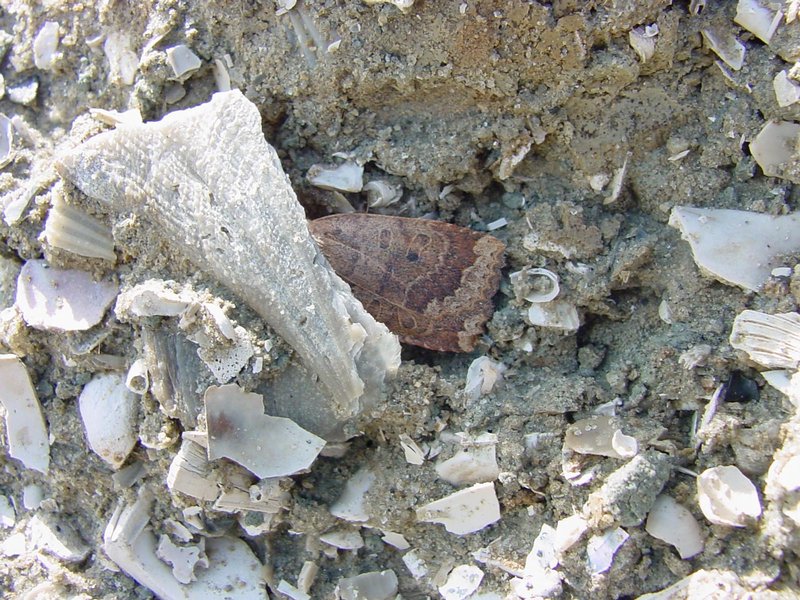
Figure 17.
Slump material from the Drumcliff Member, 6 April 2003.
An owlet moth (Noctuidae) rests partially under a piece of
Chesapecten nefrens. The small roundish valve is from “
Spisula”
subcuneata.
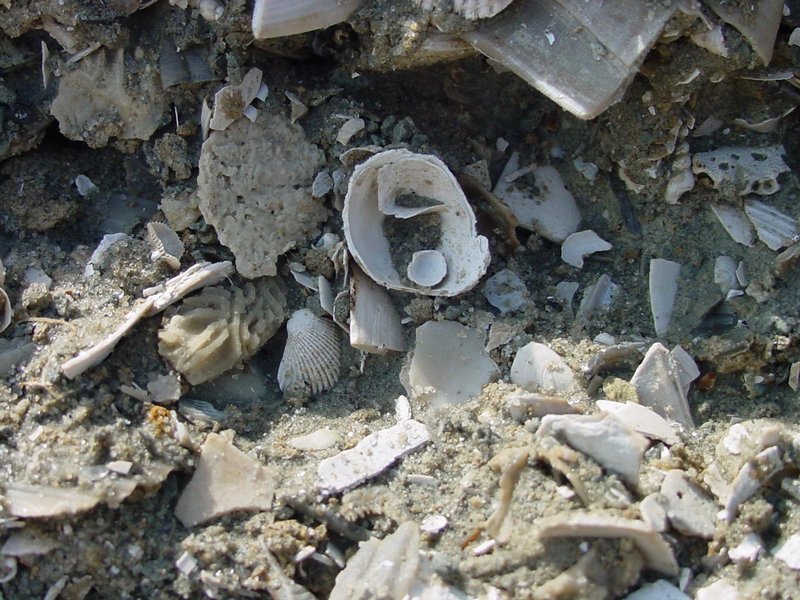
Figure 18.
Slump material from the Drumcliff Member, 6 April 2003.
A shell of
Crucibulum multilineatum, a valve of “
Spisula”
subcuneata, two pieces of
Abertella aberti, etc.
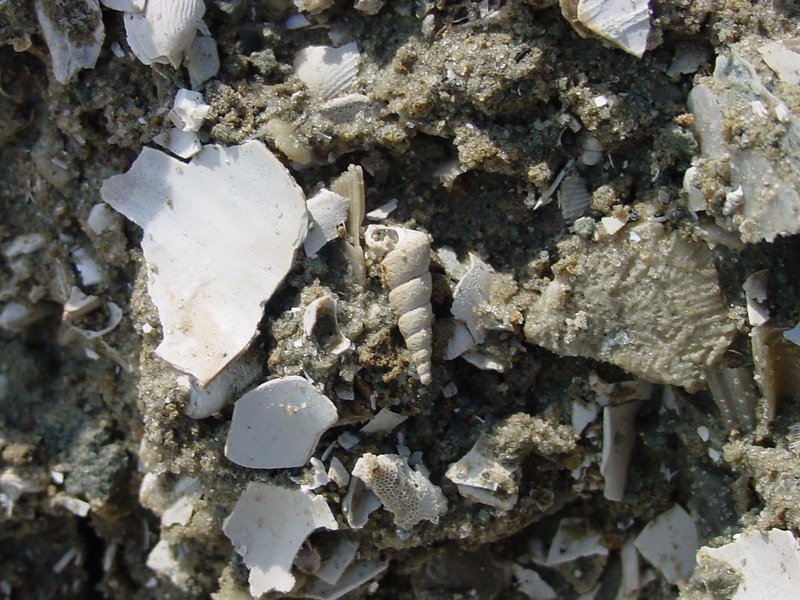
Figure 19.
Slump material from the Drumcliff Member, 6 April 2003.
Turritella plebeia, pieces of
Abertella aberti, etc.
update
template
Georgetown University and Elmira College |